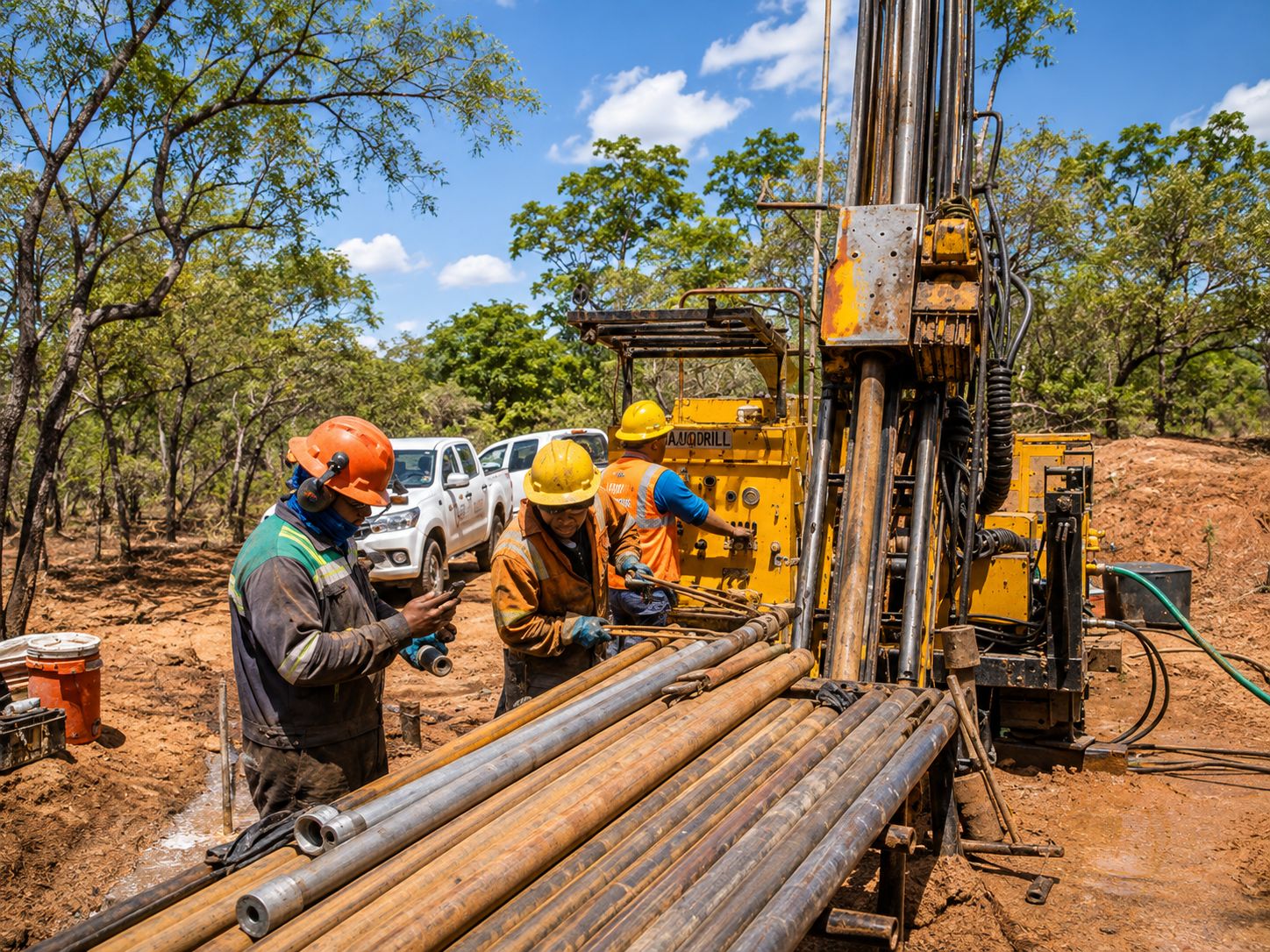

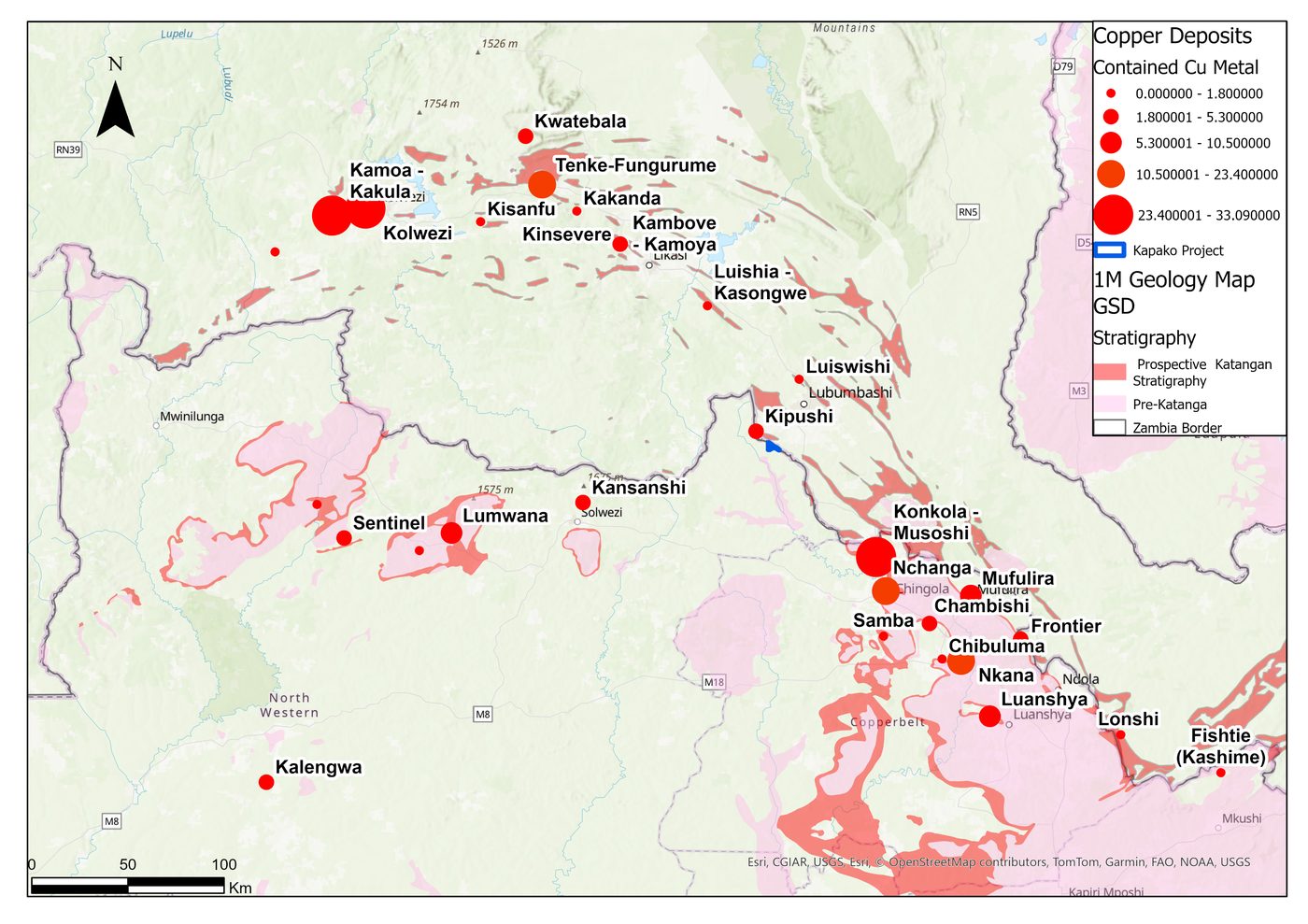
Kapako is a copper exploration project in the North-Western Province of Zambia, approximately 145 km from Solwezi, positioned inside the Central African Copperbelt — one of the world's most productive sediment-hosted copper provinces — and within 10 km of the Kipushi Cu–Zn deposit across the DRC border.
The project consolidates two contiguous small-scale exploration licences totalling 889.94 hectares: 32889-HQ-SEL, held in a 75/25 joint venture between Geophysics Explo Zambia Ltd and Her Royal Chieftainess Chikola, and 38945-HQ-SEL, held 100% by Geophysics Explo Zambia Ltd. The project is advanced in joint venture with Jimbe Minerals.
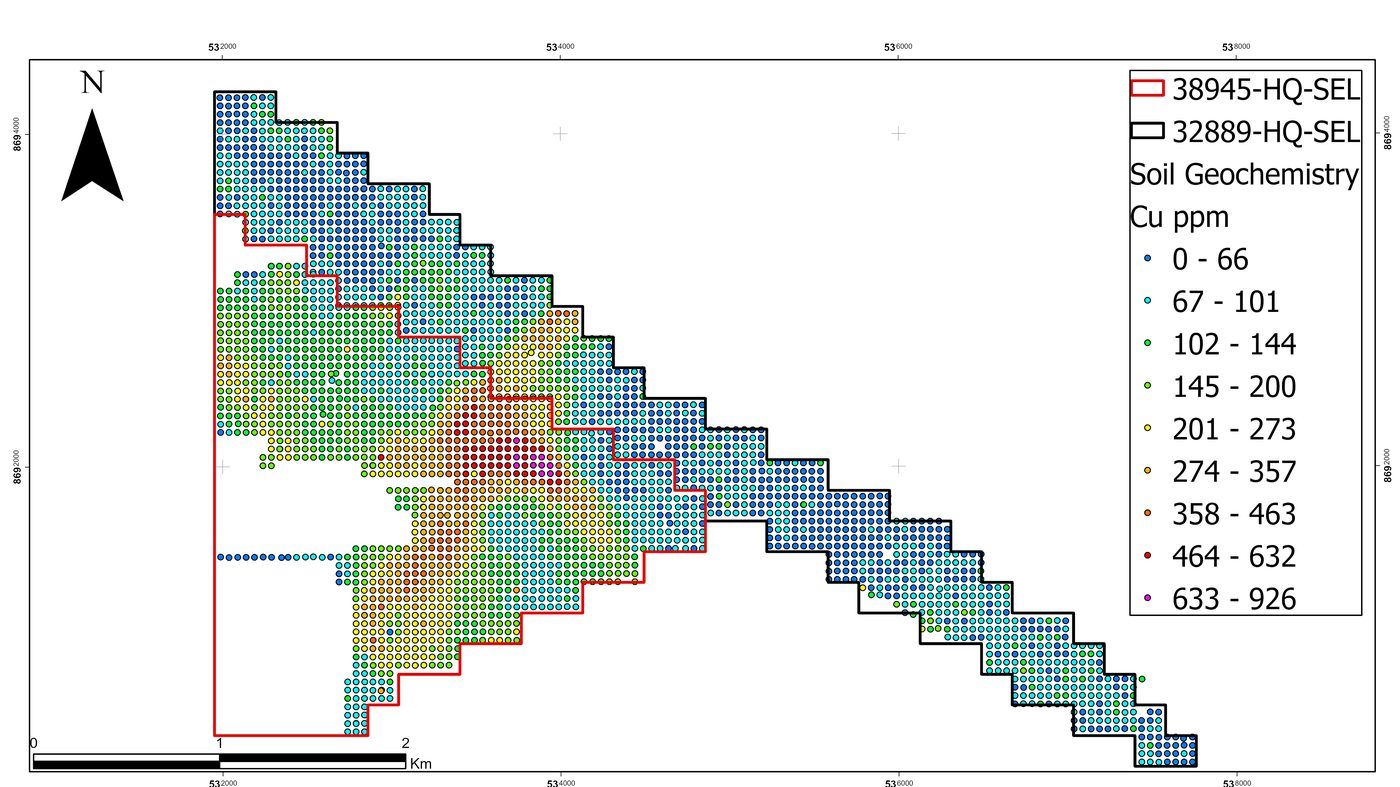
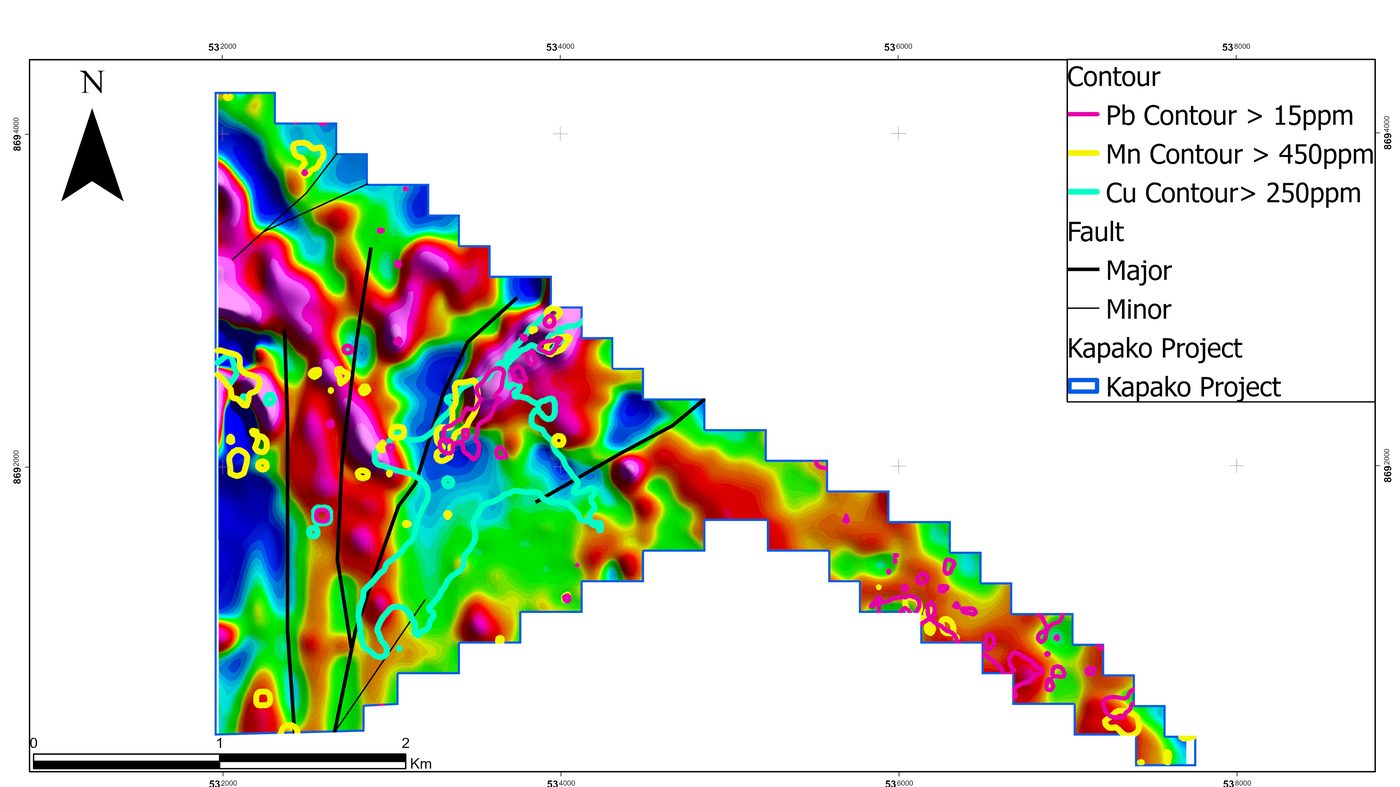
Systematic exploration — more than 3,000 soil samples on a 50 m grid, 91 line-km of ground magnetics and detailed induced polarisation — has defined a 2 km NNE-trending copper anomaly with coincident manganese, lead and zinc, controlled by the main NNE structure. An extensive diamond drilling campaign has confirmed chalcopyrite mineralisation, including massive chalcopyrite in carbonate veins and bedding-parallel sulphides in dolomitic siltstone — classic Copperbelt-style hosts. No mineral resource has been declared.
Completed, Ongoing and Planned Work
Exploration results are reported as geological evidence. No mineral resource or mineral reserve has been declared at Kapako, and no assessment of economic viability has been completed.
Inside a Major Copper Province
The Central African Copperbelt hosts one of the greatest concentrations of sediment-hosted copper deposits on Earth, and Kapako sits within it. The Kipushi Cu–Zn deposit lies within 10 km of the project across the DRC border — an indicator of the fertility of the surrounding stratigraphy and structures. No inference is drawn as to grade or tonnage at Kapako from that proximity.
The project is reached from Solwezi, the commercial hub of Zambia's newer copper district and service centre for the Kansanshi, Lumwana and Kalumbila mining operations. See Why Zambia for the wider jurisdictional context.
A 2 km Structurally Controlled Copper Trend
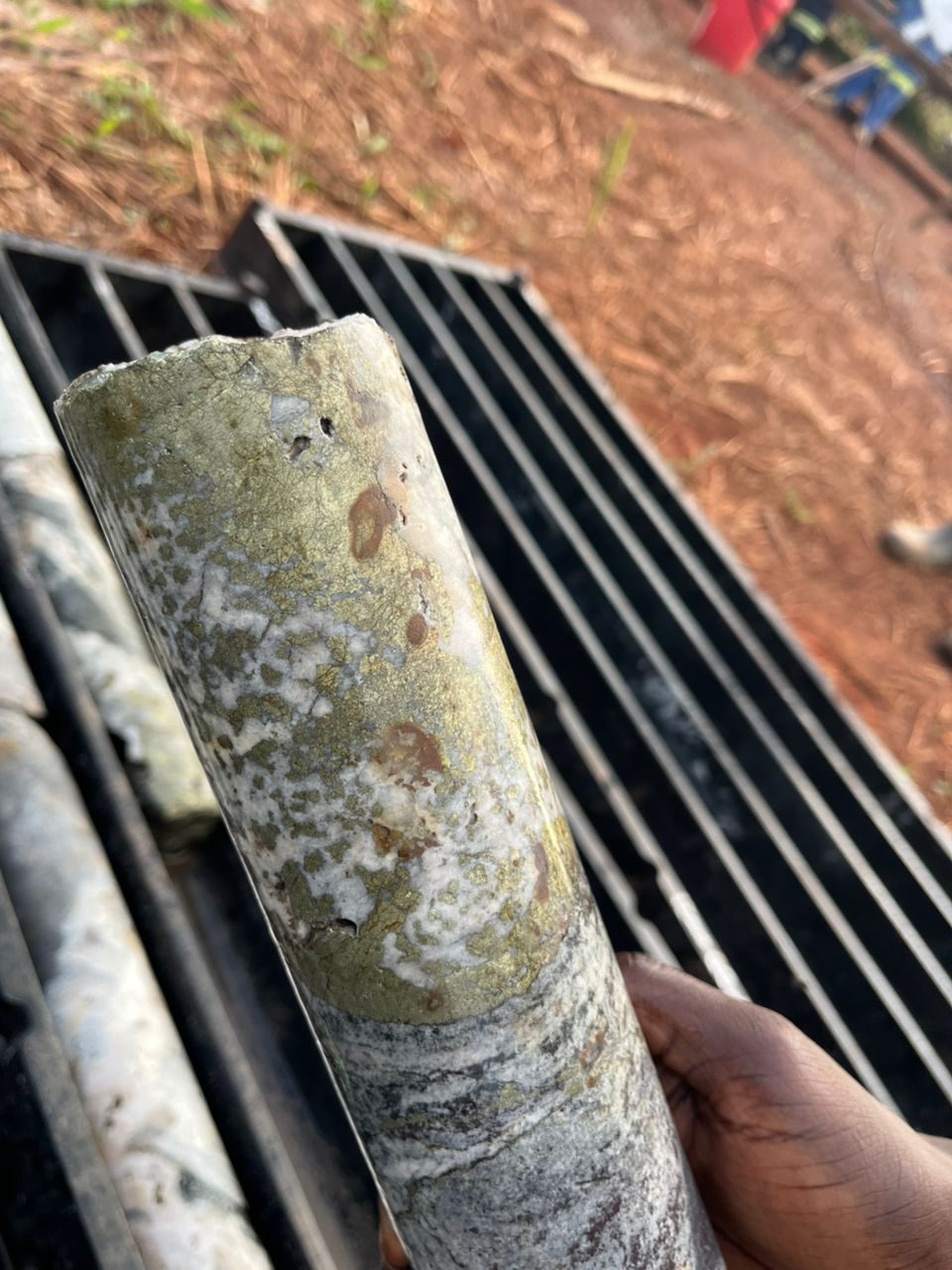
Copper Mineralisation Confirmed by Drilling
An extensive diamond drilling campaign — more than 35 holes completed, with the programme ongoing — has tested the coincident soil and IP anomalies. Mineralisation is dominantly chalcopyrite with secondary chalcocite rimming pyrite, occurring as fine bedding-parallel disseminations in dolomitic siltstone, and as carbonate veins carrying massive chalcopyrite, with malachite in the sparse oxide zone.
These are characteristic textures and hosts of the Central African Copperbelt's sediment-hosted deposits. The soil anomaly straddles the IP chargeability-and-resistivity anomaly, and structural measurements on the mineralised veins define a consistent orientation — supporting a coherent, structurally controlled system. These are exploration results only; no resource estimate has been prepared.
Technical Documentation — Available Under NDA
Drill logs and core photography, geophysical datasets (magnetics, IP voxels), soil geochemistry databases and tenure documentation are made available to qualified investors through our secure data room following execution of a confidentiality agreement.
Private investors: the portfolio is open to private participation — see the Investment Opportunity.